Your Personal Health Consultations Before Massage

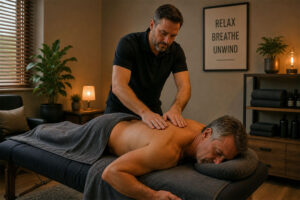
Health benefits to massageA health consultation is a simple but important part of your massage. It gives us a chance to get to know you, understand what you want from your treatment and make sure your massage is safe and comfortable for you.

On your first visit, we will ask about your health, any aches or areas of concern, and what you would like to get from your massage. We will also ask about anything that may mean massage is not suitable for you, or that may affect how we treat you. These are known as contraindications. Your first consultation usually takes around 15 minutes. Future visits are often much quicker, as we will already know your main needs and preferences.

At Relaxing Massage, every treatment is client-centred. This means your massage is tailored to you rather than following the same routine for everyone. Tell us what you would like, what feels good and what you would prefer us to avoid. We will then do our best to make your massage relaxing, comfortable and suited to your needs.

The aim is simple: a safe, personal massage that helps you feel relaxed and well cared for.

Client-Centred Treatment

With a holistic therapy the treatment should be client-centred. We make this part of our code of conduct and procedures. You as a client must consent to both a consultation and the treatment. This initially is done verbally before treatment. Then you will also be asked to sign a declaration after your personal health consultation takes place. (NHS 2018) This firstly enables us to access if massage can help you. Secondly, in means we can personalise a treatment especially for you. Lastly, the consultation will indicate if it is safe to massage you. Our aim is always to do good for you. You should always go away feeling better than when you arrived.

The Holistic Approach

Your consultation will be looking at your health and wellbeing in detail. We are looking for issues we can help you with and areas you enjoy being treated. We want to know where your aches and pains are to treat these. Also where stress related tension in muscles is, as this can be relaxed by treatment. We look at the whole picture of your lifestyle, issues like diet and exercise. It is all part of the holistic treatment. Every thing you do in life affects your wellbeing. We want you to get the best out of life with the aid of our treatment.

Your Personal Preferences

Each consultation will also take into account your personal preferences. We want to know the areas you like being massaged the most. If you tell us, you enjoy your arms massed a lot, then we will spend more time working in this area. We want to make the experience as good as possible for you. However, some people do not like their stomach being massaged. So, when you tell us this, we plan your treatment avoiding that area. Others have very ticklish feet, which would mean they laugh and get tense if feet are massaged. So, we would plan to avoid these areas. Sporty people gain special benefit from our holistic approach. Just imagine, as a cyclist you may have specific areas, like your legs, that are tense, painful and/or strained. We will take note of this and ask if you would like us to treat that area specifically to try to alleviate some of the pain. It is all done on an individual basis.

Contraindications to Massage

The consultation will also be looking for something called contraindications to massage. Contraindications are reasons we as professionals cannot give you a massage, or reasons why extra care has to be taken or that a doctors permission is required before treatment. This includes women being pregnant, certain major and minor medical conditions or if you are undergoing medical treatment for a condition. In some circumstances, especially the latter, you may need to get your doctors consent before we can treat you.

Minor contra-indications to massage

These can simply be avoided during a treatment.

  • Large, inflamed or lumpy moles.
  • Plates or pins supporting and bone.
  • Recent bone fractures.
  • Recent scar tissues.
  • Recent sprains or strains.
  • Small areas of skin disorders (eczema, infections, psoriasis)
  • Small bruises.
  • Small cuts or abrasions.
  • Small wind, sun or fire burns.
  • Spastic (permanently contracted) muscles.
  • Spots (acne, insect bites etc.)
  • Swellings.
  • Varicose veins.
  • Warts or skin tags.
  • Weak or overly thinned muscle tissue.
Major Contraindications to Massage

With these issues a doctor’s consent should be sought before treatment. This is especially the case if a client is on medication or being treated by a doctor at the moment.

  • Alzheimer’s
  • Bleeding wounds.
  • Cancer (historic or recent)
  • Consistently high blood pressure.
  • Consistently low blood pressure.
  • Controlled epilepsy.
  • Diabetes
  • Dementia
  • Embolism
  • Extensive bruising
  • Multiple scleroses
  • Neuralgia (chronic facial pains)
  • Heart conditions that are not stress related.
  • Parkinson’s
  • Phlebitis
  • Thrombosis
  • Recent operations
  • Very elderly, frail people

References:

NHS (2016) Consent to treatment [Online] Available at https://www.nhs.uk/conditions/consent-to-treatment/ (Accessed 2 July 2018)

Alzheimer’s Society Aromatherapy, massage and dementia [Online] Available at https://www.alzheimers.org.uk/about-dementia/treatments/alternative-therapies/aromatherapy-massage (Accessed 4 July 2018)

Diabetes UK Massage Therapy and Reflexology [Online] Available at https://www.diabetes.co.uk/alternative-treatment/Diabetes-and-Massage-Therapy-Reflexology.html (Accessed 4 July 2018)

Parkinson’s UK (2013) Complementary Therapies [Online] Available at https://www.parkinsons.org.uk/information-and-support/complementary-therapies (Accessed 5 July 2018)

Multiple Sclerosis Trust (2017) Massage [Online] Available at https://www.mstrust.org.uk/a-z/massage (Accessed 7 July 2018)

Macmillan Cancer Support Massage therapy [Online] Available at https://www.macmillan.org.uk/information-and-support/coping/complementary-therapies/complementary-therapies-explained/massage-therapies.html (Accessed 7 July 2018)

Cancer Research UK (2015) Massage therapy [Online] Available at https://www.cancerresearchuk.org/about-cancer/cancer-in-general/treatment/complementary-alternative-therapies/individual-therapies/massage (Accessed 7 July 2018)